


Concentrated Eau de Parfum: What It Means, and What It Doesn’t
What if “concentrated eau de parfum” sounds like a promise, but tells you less about a fragrance’s performance than you expect? Concentration language can seem precise, yet labels aren’t always easy to compare. A stronger-sounding term doesn’t automatically mean a scent will feel more powerful or last longer on your skin.
If you’ve used concentration as a shortcut for choosing perfume, that’s understandable. It can offer a useful clue about a formula, but it can’t define a fragrance’s character or guarantee how it will wear. The way a scent unfolds depends on more than its concentration.
This guide explains what concentration can tell you, what it can’t promise, and how to choose eau de parfum with confidence. You’ll learn how to read terms such as “concentrated,” distinguish formula concentration from perceived strength and longevity, and weigh scent character and personal preference when comparing fragrances.
Key Takeaways
- Read “concentrated eau de parfum” as descriptive wording, not a precise promise about how a fragrance will wear.
- Distinguish concentration from perceived intensity, projection, and longevity.
- Compare eau de parfum, eau de toilette, extrait, and perfume oil by their wording and product details, not assumed performance.
- Use a checklist to weigh scent character, intended setting, and personal preference when choosing.
- Explore Rayhaan Lion, Rayhaan Elixir, and Rayhaan Crimson as options in the Rayhaan eau de parfum range.
What Does Concentrated Eau de Parfum Mean?
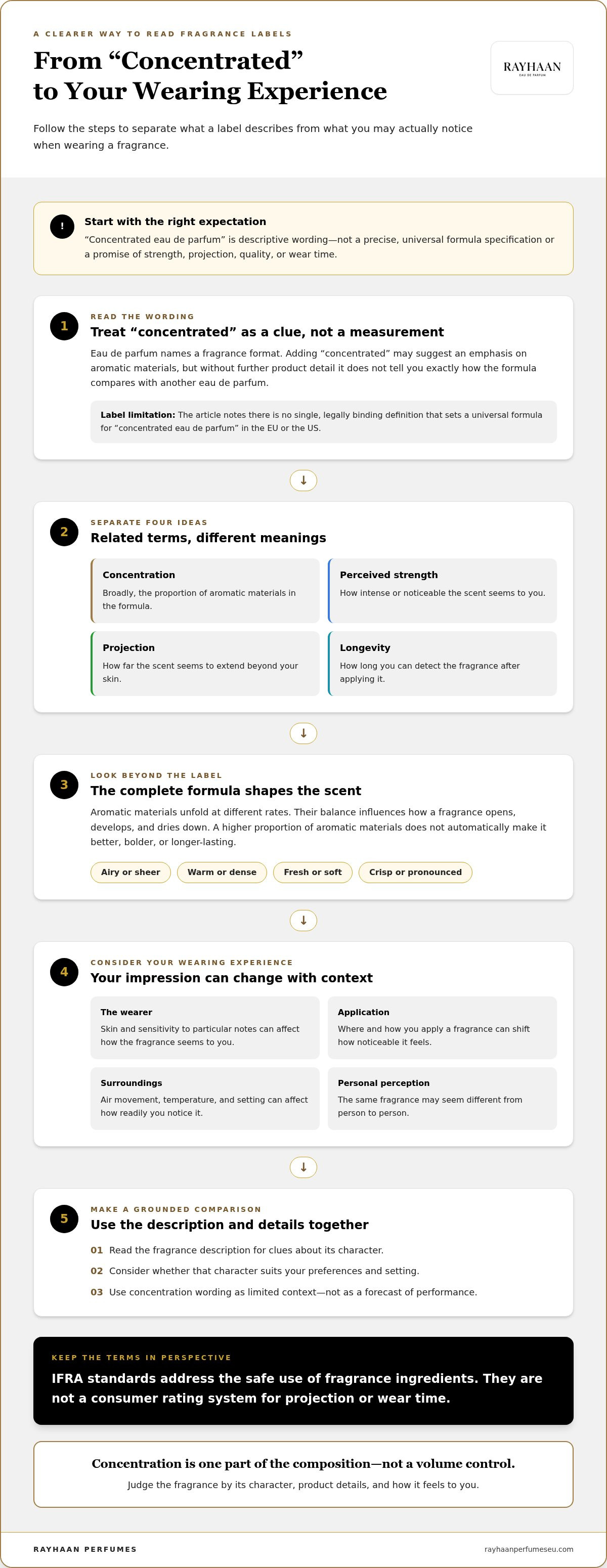
“Concentrated eau de parfum” is descriptive wording, not a universally precise formula specification. Eau de parfum names a fragrance format. Adding “concentrated” may suggest an emphasis on aromatic materials, but without further detail, it doesn’t tell you exactly how the formula compares with another eau de parfum.
That distinction matters when you’re comparing products. Fragrance labels can help explain how a product is presented, but the wording alone doesn’t establish a guaranteed level of strength, quality, projection, or wear time. For a broad overview of common fragrance categories and terminology, see Perfume concentration and types.
In short, “concentrated” is a clue about how a fragrance is described, not a promise of how strongly it will smell or how long it will last.
Is concentrated eau de parfum a standardised term?
No single, legally binding definition sets a universal formula for terms such as eau de parfum or “concentrated eau de parfum” in the EU or the US. Eau de parfum is an established industry format, while added concentration wording may vary between brands and product descriptions. Treat it as context, not a precise number, unless the product details explain what the brand means.
What does concentration describe in a fragrance?
Concentration refers broadly to the proportion of aromatic materials in a fragrance formula, rather than its scent style. Those materials are blended with other ingredients to create the finished product. A higher proportion doesn’t automatically make a fragrance better, bolder, or longer-lasting. Its effect depends on the complete formula and the materials used.
Think of concentration as one part of the composition, not a volume control. Fragrances can use similar concentration language yet smell very different. One may feel airy and sheer, while another comes across as warm or dense. The balance of materials shapes the scent’s character, including how it opens and develops over time.
Your experience also depends on where and how you wear a fragrance. Skin can influence how its facets emerge, and the same scent may seem different from person to person. Application, setting, and your sensitivity to particular notes can affect how noticeable it feels. A label can’t predict everyone’s experience with precision.
When you encounter the phrase, read the product description alongside it. Look for words that communicate character, such as fresh, soft, rich, or expressive. Those descriptions offer clues about the intended scent profile, while the concentration label provides limited context about format. Considering both gives you a clearer expectation without assuming a particular performance.
Why Concentration Does Not Guarantee a Stronger or Longer-Lasting Scent
A higher-sounding concentration label can create the expectation of a more powerful fragrance that stays noticeable for longer. But concentration alone can’t promise either result. It describes one aspect of a formula. The experience of wearing a scent also depends on how its materials are blended, how it develops, and how it interacts with you.
Concentration is one part of a fragrance’s performance, not a reliable forecast of how loudly or how long it will wear. Two fragrances with similar format wording can feel quite different, and the same fragrance may seem more noticeable to one person than another.
Concentration, strength, projection, and longevity are different
These terms describe related but separate things. Keeping them distinct makes product descriptions easier to interpret:
- Concentration refers broadly to the proportion of aromatic materials in the formula.
- Perceived strength is how intense or noticeable the scent seems to you.
- Projection describes how far the scent seems to extend beyond your skin.
- Longevity is how long you can detect the fragrance after applying it.
Imagine two scents. One opens with a vivid, attention-catching impression but feels close to the skin later. Another starts softly and remains gently perceptible to you. The first may feel stronger at the start, while the second may seem to last longer. Neither impression can be deduced from “concentrated” alone.
Fragrance standards can also be easy to misread. The International Fragrance Association (IFRA) standards address the safe use of fragrance ingredients; they aren’t a consumer rating system for projection or wear time. A format label and a safety standard serve different purposes.
Why the same fragrance can wear differently
The complete formula matters. Different aromatic materials unfold at different rates, and their balance shapes a scent’s opening, development, and dry-down. This is why concentration alone can’t tell you whether a fragrance will feel crisp, soft, warm, or pronounced as the day goes on.
Application and surroundings can shift your impression, too. A fragrance applied to one area may be more noticeable to you than the same scent applied elsewhere. Air movement, temperature, and setting can affect how readily you notice it. Your skin and sensitivity to particular scent facets also play a part, so another person’s experience may not match yours.
For a practical approach to application, explore these practical tips for wearing fragrance well. When comparing concentrated eau de parfum, focus on the fragrance description and stated product details. Then consider whether its character suits your preferences and setting. You can also explore the Rayhaan eau de parfum range with those points in mind.
Concentrated Eau de Parfum Compared With Other Fragrance Formats
Fragrance format names offer a useful starting point, but they aren’t a universal performance ranking. Eau de parfum, eau de toilette, extrait, and perfume oil describe different ways fragrances are presented or classified. Brands can use terms and formulate products differently, so read the wording alongside the product description. The overview below explains what each label may indicate, not what performance it guarantees.
| Format wording | Typical presentation | What to check |
|---|---|---|
| Eau de parfum | Commonly presented as a spray fragrance. | Read the scent description and stated product details. The label alone doesn’t predict how it will wear. |
| Eau de toilette | Also commonly presented as a spray fragrance. | Compare the product’s description with your preferences instead of assuming it will be lighter or shorter-lasting. |
| Extrait | Often presented as an extract-style fragrance. | Look for the brand’s explanation of the format and intended use. The name doesn’t guarantee greater quality. |
| Perfume oil | An oil-based format, which may be applied differently from a spray. | Check the application method and product instructions, as these can shape the wearing experience. |
These are broad conventions, not fixed technical definitions. For wider context on fragrance craft and industry, explore fragrance industry insights from The Fragrance Foundation. Its educational perspective can help you appreciate the artistry behind scent, while a product’s own details remain the best guide to that particular fragrance.
Eau de parfum and eau de toilette: a concise distinction
At a high level, eau de parfum and eau de toilette are familiar format labels, often used to distinguish products within a brand’s range. Their precise meaning can vary, so avoid treating either as a promise about how strong or lasting a particular scent will feel. For broader online shopping guidance, use an eau de parfum buyer’s guide to help structure your comparison.
Extrait and perfume oil: related formats, different experiences
Extrait and perfume oil relate to the same world of fragrance, but they aren’t interchangeable terms. Extrait generally names a fragrance format, while perfume oil describes an oil-based presentation. Neither label automatically means higher quality or better performance. Check how the product is described and applied, then consider whether that format suits your routine.
So where does concentrated eau de parfum fit? Treat it as product wording that needs context, not as another name for extrait or perfume oil. Compare the exact label, stated format, and fragrance description before drawing conclusions. That habit keeps the focus on the scent you’ll choose, rather than assumptions tied to a single word.
How to Assess a Concentrated Eau de Parfum Before Choosing
A thoughtful choice starts with the product details, not the strongest-sounding phrase on the page. Use this checklist to separate what the product information states from what a label might lead you to assume.
- Start with the exact wording. Note whether the page says “eau de parfum,” “concentrated eau de parfum,” or something else. Treat each phrase as written. Don’t translate it into a formula percentage unless the product details provide one.
- Read the full description. Look for the stated fragrance format and the product’s explanation. If scent notes or a fragrance profile are provided, use them to picture its character. Don’t infer ingredients or formula strength from evocative marketing language.
- Consider the setting. Think about where you want to wear the fragrance, whether for everyday plans, an evening out, or another occasion. Ask whether the described character suits that setting instead of assuming concentration determines when it belongs.
- Check the application details. Follow the product’s stated instructions. Format can affect how a fragrance is applied, so don’t assume products with different presentations are used in the same way.
- Sample and observe, where possible. Try the fragrance on your skin and notice how its character develops for you. Your own impression is more useful than a general promise inferred from the label.
- Choose for your preferences. Decide whether the described scent appeals to you and fits your routine. A format label can inform your comparison, but it can’t choose a fragrance on your behalf.
Checklist in one line: Treat stated product details as facts; treat assumptions about strength, quality, and wear time as assumptions.
Read the product description beyond the concentration label
Begin with the precise format wording, then look for the product’s explanation of the fragrance. A listed note or scent profile can help you assess whether its character appeals to you. Promotional terms don’t establish a formula percentage, disclose every ingredient, or guarantee performance. Let the details guide your expectations, not replace them.
Match the fragrance to your preferences and routine
Think about the moods and occasions you want a fragrance to suit. If sampling is possible, apply it as directed and notice how it smells to you as it develops. There’s no need to expect a set number of hours. To plan for different moods and occasions, a guide to building a fragrance collection can help you think about the role you want each scent to play.
Ready to compare fragrance options? Explore Rayhaan’s eau de parfum range and use the checklist to guide your choice.
Explore Rayhaan Eau de Parfum With Clearer Expectations
Once you know what concentration wording can and can’t tell you, product discovery becomes more straightforward. Rayhaan’s eau de parfum lineup includes Rayhaan Lion, Rayhaan Elixir, and Rayhaan Crimson. The names identify the fragrances, but they don’t tell you which scent character will suit you best. Compare the product details and let your preferences guide your choice.
Compare the Rayhaan eau de parfum lineup by its published details
Compare Rayhaan Lion, Rayhaan Elixir, and Rayhaan Crimson by reading the information provided for each fragrance. Look at the scent profile and other stated details. Avoid ranking them by assumed strength or longevity, and don’t infer notes or formula details from a name alone.
A simple way to compare is to ask yourself the same questions for each fragrance:
- What character does the description communicate? Consider whether the stated profile sounds like something you’d enjoy wearing.
- What details are actually provided? Separate product information from assumptions based on words such as “rich,” “intense,” or “concentrated.”
- Does it suit the role you have in mind? Think about your routine and the occasions for which you’re choosing a scent.
- Which one would you most like to experience? Your response to the described scent character is a more personal guide than a general expectation tied to format.
This approach keeps the comparison fair. You’re not trying to decide which fragrance is objectively strongest. You’re working out which description aligns most closely with your taste, then using any available sampling to see how that fragrance feels on you.
Make a confident choice without relying on the label alone
Keep the decision simple: understand the stated format, read the fragrance description, and consider your preferences. “Eau de parfum” gives you format context; it doesn’t replace the product’s own details or your response to its scent. The phrase concentrated eau de parfum shouldn’t outweigh those more useful clues or be treated as a guarantee of performance.
For a broader look at the range, compare the information for each Rayhaan fragrance rather than choosing based on a single label. The best fit is the one whose stated character appeals to you and feels right for your routine.
Explore Rayhaan eau de parfum and discover which description speaks to your taste.
Choose the Scent That Feels Like Yours
Your next fragrance choice can be guided by curiosity, not by a label that sounds more powerful. Treat concentrated eau de parfum as one detail among many, then give the scent itself room to make an impression. A fragrance you enjoy wearing is a more meaningful choice than one selected to meet an assumed performance expectation.
As you explore, notice which descriptions draw you in. Think about the mood you want, the settings where you’ll wear the scent, and whether its character feels right for your personal style. If you can experience it on your skin, pay attention to your own response as it develops. Trust your taste over a promise you’ve read into the wording.
Rayhaan Perfumes’ online storefront offers Rayhaan eau de parfum fragrances to explore and compare. Consider the product details, decide which scent character appeals to you, and choose with confidence.
Explore Rayhaan eau de parfum and discover a scent that feels like your own.
Frequently Asked Questions
Is concentrated eau de parfum stronger than regular eau de parfum?
Not necessarily. The word “concentrated” doesn’t establish a consistent comparison between products or guarantee how strong either will seem to you. One fragrance might make a vivid first impression while another feels softer, even if its label sounds more intense. Compare their scent descriptions and consider your own preference for subtle or noticeable scents. If sampling is possible, your experience can help you choose.
Does concentrated eau de parfum last longer?
The phrase alone can’t tell you how long a particular fragrance will remain noticeable. Treat product descriptions as context, not as a fixed wear-time promise. You could apply a fragrance as directed on a day when you have time to notice how it develops, rather than judging it only from its opening impression. Your perception may differ from someone else’s.
Is concentrated eau de parfum the same as extrait de parfum?
No, don’t assume the terms mean the same thing. Eau de parfum and extrait de parfum are different format descriptions, while “concentrated” may describe how a product is positioned or discussed. Usage can vary by brand. If a page mentions more than one term, read the stated format and product explanation together. That helps you avoid treating separate labels as proof of identical formulas or experiences.
Can a concentrated eau de parfum smell lighter than another perfume?
Yes. A concentration label doesn’t dictate whether a scent feels airy, soft, or prominent. For instance, you might find a fragrance described as fresh and delicate less noticeable than another described as rich, regardless of how their labels compare. Your sensitivity to particular scent facets also shapes your impression. Read the profile for clues about character, and try the fragrance on skin where possible.
How should I choose a concentrated eau de parfum online?
Start with the exact format wording, then read the full product description for its stated scent profile and application details. Compare those details with fragrances you already enjoy. If you prefer a gentle everyday scent, look for descriptions that appeal to that preference rather than inferring intensity from “concentrated.” Don’t assume the phrase reveals ingredients, a percentage, or wear time. Choose for the scent experience you want.


